You Don't Need More Time. You Need More Consistency.

You Don't Need More Time. You Need More Consistency.
Why daily mental performance practice is the most underrated habit in sport
You train your body every day. You log the reps. You track the miles. You show up even when you're tired because you know consistency is what builds real fitness.
But your mental game? Most athletes treat it like a fire drill. They only think about it when something goes wrong.
That's backwards.
Mental performance is a skill. And like every other skill, it has to be practiced. Not occasionally. Not only during slumps or big games or when your coach tells you to. Consistently. Intentionally. Daily.
The good news: it doesn't take much time. We're talking 5 to 10 minutes a day. What it does take is commitment. And that's the part most athletes skip.
Mental toughness isn't something you have. It's something you build, one day at a time.
Why Consistency Beats Intensity
Think about how you built your physical skills. You didn't get faster by sprinting once a month. You didn't get stronger by lifting twice a season. You got better because you showed up again and again, and over time, the training compounded.
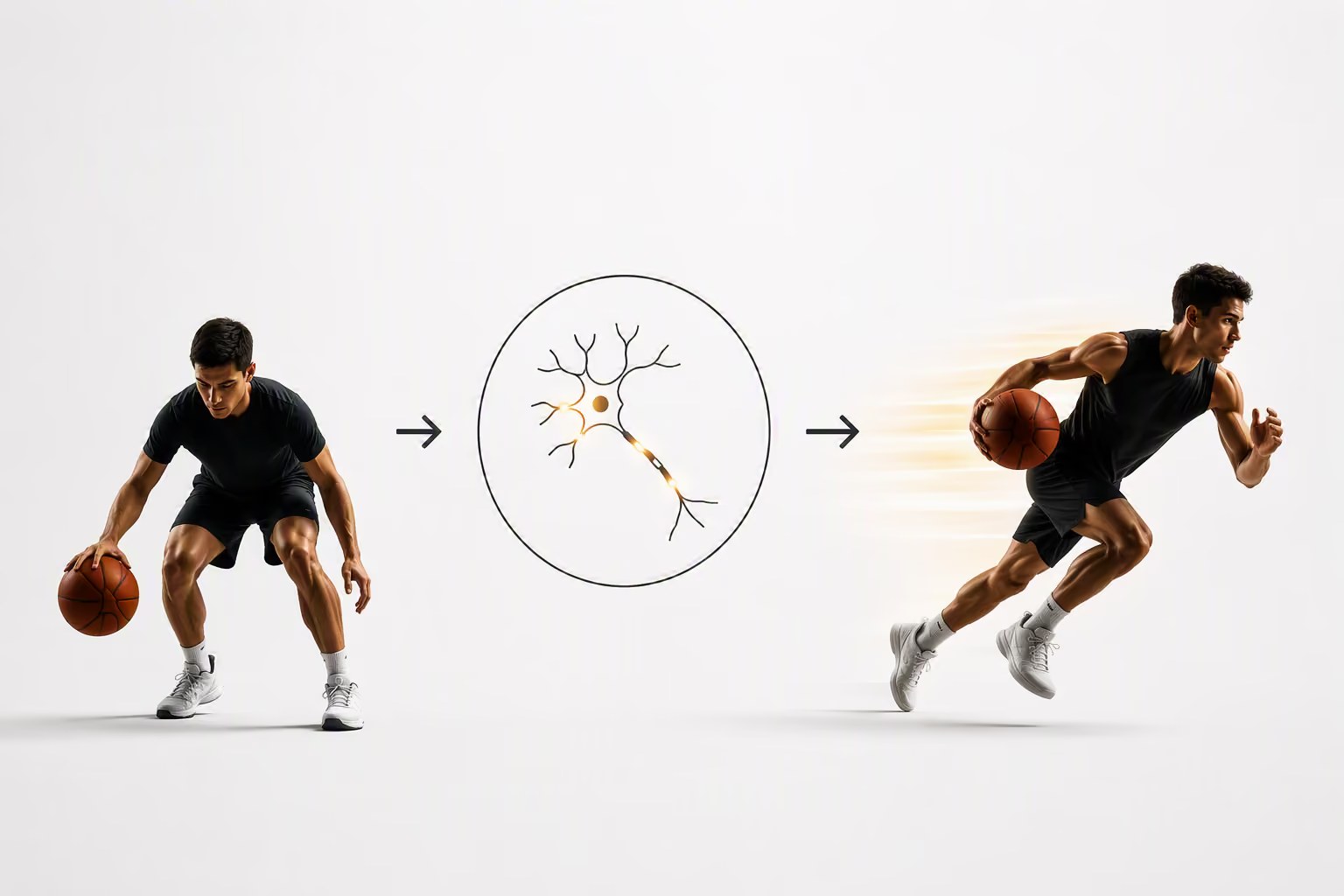
Mental performance training works the same way. Neuroscience tells us that the brain changes through repetition. Every time you practice a mental skill, like focusing under pressure, managing self-talk, or building pre-performance routines, you're reinforcing neural pathways. You're literally rewiring how your brain responds in competition.
One long mental performance session doesn't do that. Five minutes every morning for 90 days does.
This is the part athletes miss. They think mental training has to be dramatic or time-consuming to count. It doesn't. Short, consistent practice is more powerful than occasional intensive sessions, every time.
What Consistent Practice Actually Looks Like
You don't need a sports psychologist sitting across from you every day. You don't need an hour carved out of your schedule. What you need is a few minutes of intentional mental work built into your daily routine.
Before practice. After lifting. Before bed. Whenever works. The key is that it happens regularly, not just when you feel like it.
Here are the three most important things you can work on:
1. Breath Control and Activation Management
Your ability to control your breathing is your most direct tool for managing your physiological state. When anxiety spikes before a big game, your heart rate goes up, your muscles tighten, your focus narrows. Breath control is how you regulate all of that.
The skill is simple: slow, controlled inhale through the nose, extended exhale through the mouth. Box breathing (inhale 4, hold 4, exhale 4, hold 4) is one of the most researched and effective protocols for athletes.
But here's the thing. If you've never practiced it, it won't work when the pressure is real. Your nervous system needs to be trained to respond to it. That only happens through repetition.
Daily practice: 3 to 5 minutes of controlled breathing each morning. That's it. Do it before you check your phone. Do it before practice. Make it automatic, and it'll be there when you need it most.
You can't use a skill in competition that you've never practiced in training. That includes the mental ones.
2. Self-Talk and Internal Narrative
The voice in your head during competition is not neutral. It's either working for you or against you. Most athletes let that voice run on autopilot, and when things get hard, autopilot usually defaults to criticism, doubt, and negativity.
Mental performance training helps you take control of that voice.
This doesn't mean fake positivity or pretending mistakes don't happen. It means learning to redirect, reframe, and refocus. It means replacing "I can't believe I just did that" with "reset, next play" before the damage compounds.
Daily practice: Start by noticing your self-talk. Spend two minutes each day writing down what you said to yourself during practice or competition. Was it helpful? Was it harsh? Over time, begin to replace the patterns that hurt you with cues that work. Keep them short, personal, and action-focused.
3. Visualization and Mental Rehearsal
Elite athletes across every sport use visualization. It's not a new concept. What is new for most athletes is understanding why it works and how to do it well.
When you visualize a skill with full sensory detail, seeing it, feeling it, hearing it, your brain activates many of the same neural pathways as actual physical execution. You're essentially getting mental reps. Mental rehearsal sharpens confidence, improves focus, and reduces anxiety because your brain has already "done" the thing before your body has to.
The key is specificity. Vague visualization doesn't produce much. Detailed, emotionally engaged, first-person visualization does.
Daily practice: Three to five minutes of deliberate mental rehearsal. Pick one skill, one scenario, or one situation you want to perform better in. See it in your mind in full detail. Run it through successfully. Then run it through again. This is a skill you build over weeks, not overnight.
Start Small. Stay Consistent. Expect a Compound Effect.
You're not going to transform your mental game in a week. That's not how it works. But if you commit to 5 to 10 minutes of mental performance practice every day, for 30, 60, or 90 days, the changes will be real and they will show up in your performance.
Sharper focus when it counts. Better emotional recovery from mistakes. More confidence when the moment is big. Improved ability to stay present instead of getting lost in outcomes.
None of that happens by accident. None of it comes from doing the work once when things get hard. It comes from showing up every day when things are fine, so that when the pressure arrives, your mental skills are already built.
That's the discipline that separates good athletes from elite ones.
Your body shows up every day. It's time your mind does too.
The athletes who perform in the big moments are the ones who prepared in the ordinary ones.
Ready to build your mental performance foundation?
At EForce Sports, we work with athletes on exactly this. Not crisis management. Proactive mental performance development that builds the foundation for sustained excellence. Reach out to learn more about how we work with athletes at every level.